By Desrae Clarke
Although the Australian Owlet-Nightjar is stated as widespread and a relatively common nocturnal bird, it is rarely observed.
It is a small bird, between 20 and 25 cms in length, with the female slightly larger than the male. It has huge eyes. It has cat-like whiskers (called vibrissae) projecting up from its lore, which is the small area of skin between the base of the tiny but broad, dusky-coloured bill.
Its colouring is of excellent camouflage. The variable upper parts are a darkish grey and finely speckled and softly barred white. Its head has a central black stripe together with a black stripe over each eye meeting at the back of the neck, where they fuse into a pale grey to white collar. Underparts are white with grey bars extending through the breast and into the throat area.
The flight feathers, the longest wing feathers, are grey spotted with rufous. The wings are shorter than the tail. The tail feathers are barred grey and rufous, and the feet are pinkish-grey with the claws a dusky colour.
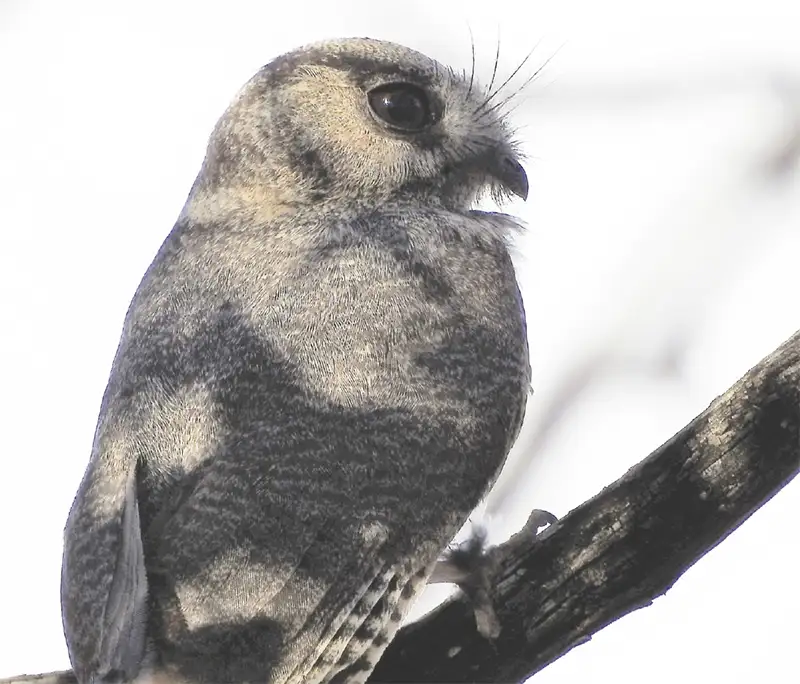
Australian Owlet-nightjar. Photo: Rob Boase.
This small nocturnal bird, which mates for life, breeds between August and December. The building of a nest, consisting of green eucalypt leaves placed in a tree hollow, stump or a fencepost, is shared by the pair with three to five white eggs laid over a couple of nights and incubated by both parents over a period of nearly four weeks.
The young fledge, having enough feathers to fly, in twenty to thirty days, after which they stay with their parents for several months.
The Nightjar has a high-pitched chirring voice that is heard all year round.
An item of interest is that the bird has a good knowledge of all the hollows within its home range. It will dart directly into one or other when disturbed. It stays in the same locality throughout the year.
A Toodyay Nat’s Club member has just found a dead Nightjar in the vicinity of her home. It had no sign of injury. Perhaps it had hit a window chasing a moth or suchlike.
I have only ever seen one of these small birds in the wild, with it pointed out by a knowledgeable ‘birdo’. It was peering out of a small hole in a tree trunk in York gum woodland with its noticeably enormous eyes.
A second bird I have seen was, unfortunately, a roadkill. Like night birds such as the Boobook Owl and Tawny Frogmouth, the Nightjar will fly towards a beam of light from vehicles to catch moths, often with dire results.
The Toodyay Naturalists’ Club welcomes sightings and observations of flora, fauna and all areas of natural history. To add your sightings, email secretary@toodyaynats.org.au or submit a sighting via our online form.