By Desrae Clarke
The Black-tailed monitor is commonly called the Racehorse Goanna. If it is moving along at a leisurely pace, it has its fine tail curled over its back. However, if disturbed, it drops its tail and moves at a lightning pace; consequently, the common name of Racehorse Goanna.
The species is commonly found within the Shire of Toodyay, often living in the roofs of buildings and rocky crevices, hollow logs or holes in the ground.
It is a slender creature of an adult length of approximately 80cms with a ground colouring of dark grey to black. Young creatures are marked with yellowish-cream spots with a darkened centre, known as ocelli.
The snout is slender with noticeable nostrils; obvious ear holes are placed back from the eyes. It has a long, slender and deeply forked tongue that plays a part in its sense of smell. The flicking movements of the tongue collect and transfer air-borne particles to Jacobson’s Organ, in the roof of the mouth, for the particles to be analysed.
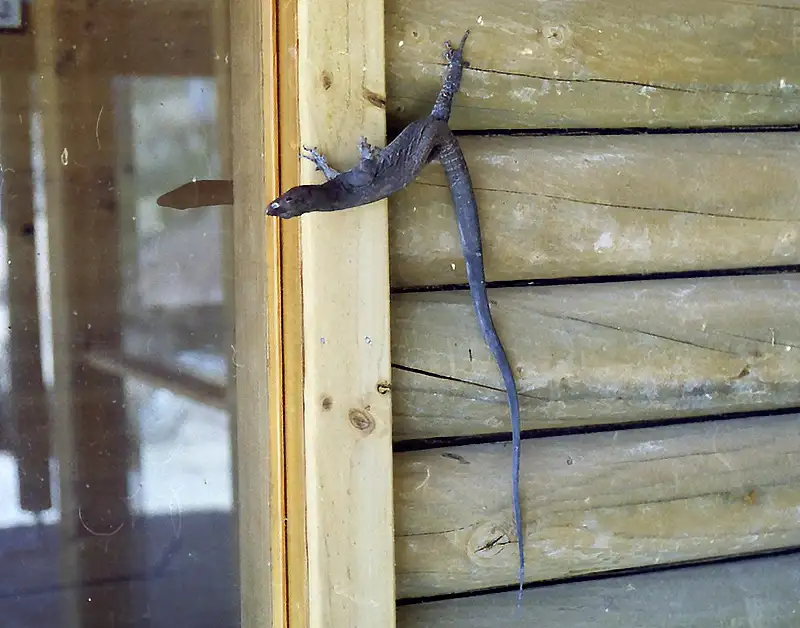
Black-Tailed Monitor. Photo by Wayne Clarke.
Small birds and lizards, as well as eggs and insects, frogs and carrion are all foods for this species. It has been observed undulating its tail through litter to flush smaller creatures as prey.
Monitors have loose skin that differs in structure from other reptiles. Their scales lie alongside each other and do not overlap.
Its claws are long and extremely strong to aid in digging or climbing trees, fence posts and walls, as can be seen by the attached photo.
It is an egg-laying (oviparous) animal depositing its leathery-shelled eggs in a termite nest or in a mound of soil. It may lay up to 35 eggs in a clutch. There have been several reports of people about to shift a mound of soil to find it is the incubating medium for a clutch of eggs.
A wonderful reference is found in ‘Australia’s Reptiles – A Photographic Reference to the Terrestrial Reptiles of Australia’, authored by Stephen K Wilson and David G Knowles. The volume has excellent photographs of the Varanidae family that consists of 30 lizards found from Africa, through Asia and the Indo-Papuan Archipelago, to Australia.
The Indonesian Komodo Dragon and the largest lizard in Australia, the Perentie, are both members of this family.
The Toodyay Naturalists’ Club welcomes sightings and observations of flora, fauna and all areas of natural history. To add your sightings, email secretary@toodyaynats.org.au or submit a sighting via our online form.