By Desrae Clarke
As is evident the changing weather is welcoming reptiles from their winter rest.
There have been reported sightings of a long slender dugite, a number of bobtails, including the sad remains of road-kills, the black racehorse goanna with its tail arched over its back, the Gould’s sand monitor, a large, fat, irritated blind snake, a broad-banded sand-swimmer and a spotted burrowing frog.
When visiting friends in suburban Perth a West Coast Ctenotus appeared for a very short period. The West Coast Ctenotus, measuring 84-90mm, is a handsome reptile with a very shiny body and a tail more than twice the snout vent length (SVL). The SVL is the length from the tip of the snout to the vent between the back legs.
With information given to me by well-known naturalist, the late John Dell, a typical home is of soil beneath a hard surface into which it can burrow.
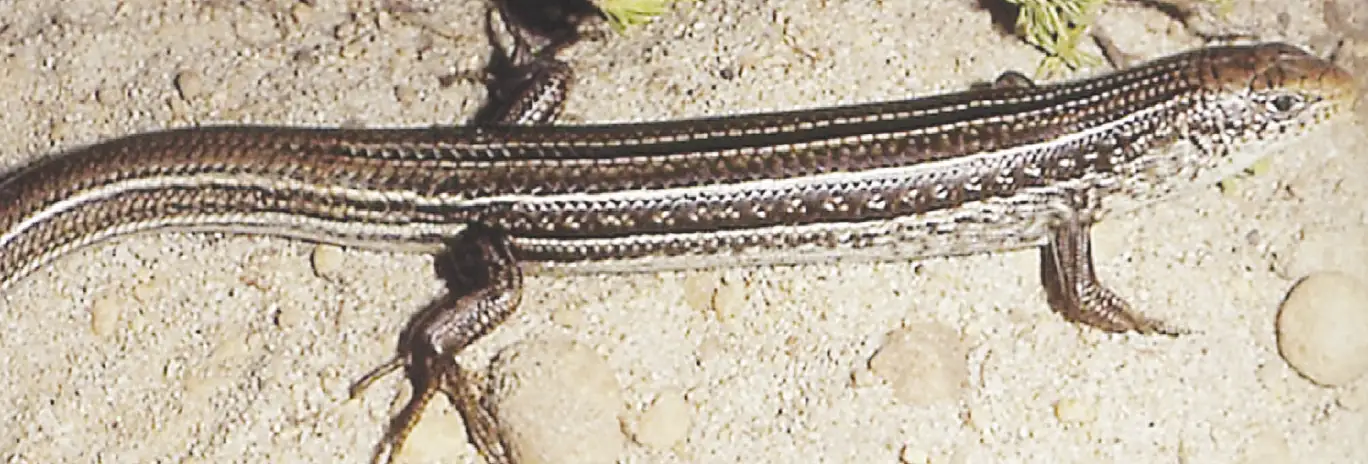
The West Coast Ctenotus. Photo courtesy ‘Guide to the Reptiles and Frogs of the Perth Region’ By Brian Bush, et al.
There are many species of Ctenotus with similar colouring and patterning but slightly different scale formation. The ground colour of the West Coast Ctenotus ranges from pale greyish-brown to yellowish-brown and blackish in juveniles.
The back patterning has four narrow white stripes running the length of the body to the base of the tail. A vertebral stripe of blackish-brown to black edged with white, runs from the nape to the base of the tail. A white stripe running from the eye tends to become diffused with brown or yellow on the tail. The upper dark brown stripe runs from the nape to the base of the tail enclosing small white blotches and dashes. The belly is silver-white, grey-cream or yellow; it is thought the yellow may be a breeding colouration.
Four soft-shelled eggs are laid (oviparous) with the young hatching in February; they are approximately 38-41mm in length. Food taken by this little skink consists of a variety of insects.
The Toodyay Naturalists’ Club welcomes sightings and observations of flora, fauna and all areas of natural history. To add your sightings, email secretary@toodyaynats.org.au or submit a sighting via our online form.