By Desrae Clarke
The Darter is often called the Snake Bird because of its long, sinuous neck.
This species floats very low in the water with only its head and neck visible. It can slip silently beneath the water, without as much as a ripple, to hunt its prey of small fish, insects and other aquatic animals.
It holds back its snake-like head until the quarry is within reach, then spears it with its bill. Reversed serrations on the bill prevent the creature from escaping.
Male and female darters have different-coloured plumage. Yellow naked skin surrounds the brown, yellow or orange-coloured eye and is also found on the throat.
The bill is brown above, yellow below, and the feet and webs are a pinkish grey. Females are generally grey-brown above and have a white or pale buff underbody. The stripe on the side of the head has dark edges, with the upper wing covers striped pale grey.
Darters make brassy, clanging calls and, during nesting times, a harsh repeated ‘kah’ that decreases in volume after a few calls. At the time of mating, the male issues a “khaah” while the female makes a “tjeeu” sound.
A territorial hissing is made near the nesting tree. Breeding is normally in spring and summer, although the species will breed in any month depending on food availability.
The male begins making a nest platform of loose sticks in either a live or dead tree over water. The nest is lined with fresh, leafy twigs to attract passing females.
Once the courtship is over, the male will continue to build the nest before the female lays its clutch of four to six chalky-white, green-tinged eggs. Incubation, by both parents, is over a period of around four weeks, with the first egg laid hatching first.
Both parents feed the chicks and protect the young by covering them with their wings. The young fledge (have feathers enough to fly) after about seven weeks.
Although not a common bird within our shire, it is known to visit the Avon River and some of our larger waterways that are either fresh or salty riverine waters, lakes and dams, or wherever there is still water.
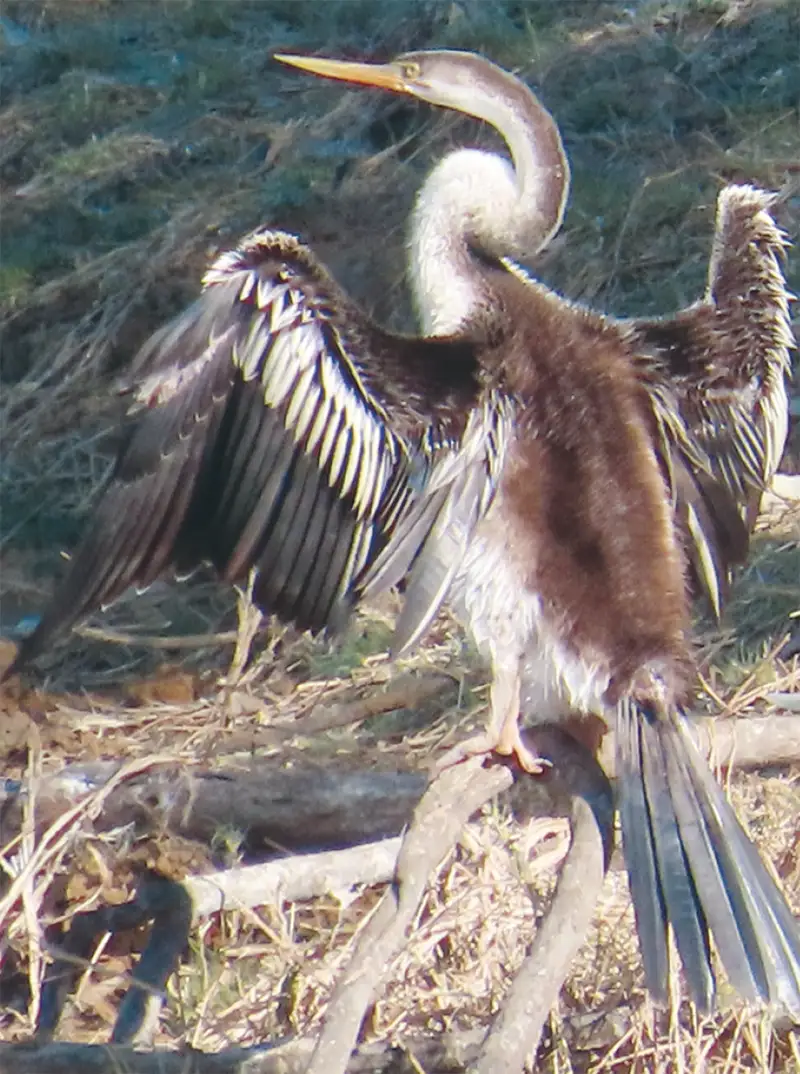
The Darter. Photo: Lyn Johnson.
The Toodyay Naturalists’ Club welcomes sightings and observations of flora, fauna and all areas of natural history. To add your sightings, email secretary@toodyaynats.org.au or submit a sighting via our online form.