
By Desrae Clarke
The Little Black Cormorant is more common on inland waters than coastal. However, it can also be found on coastal estuaries and is quite prolific in the southwest of the state.
The sexes are similar, with the female slightly smaller than the male bird.
This small, slim cormorant, of approximately 60cm length, is all over black, but in the sunlight, it is noted to have a metallic green sheen to the upper body.
During breeding, the adult plumage may turn to a bronze colouring and its head and neck sparsely flecked white.
The Little Black Cormorant has dark purple-grey facial skin, brown eyes and black feet.
This species has a black, longer and more slender bill than the Little Pied Cormorant, giving it a slightly different and wider diet type.
Its prey is fish, and rafts of the birds cooperatively herd fish into shoals.
Once out of the water, it will perch on dead trees, sandbars or banks to dry.
It is fast flying, alternating in a flapping/gliding pattern. The birds fly one behind the other, or in a ‘v’ formation, and can often be seen flying,
back and forth, along our river.
It is a communal bird. It nests in colonies often with other species of cormorants, herons, ibis and spoonbills. The nest is a platform of sticks, leaves, bark and other debris with a lining of feathers and constructed in trees over water.
The birds usually breed in spring/summer with a clutch of three to five greenish-white, chalk-covered eggs incubated over a three-to-four-week period by both adults.
The Little Black Cormorant is normally a silent bird away from the nest, but will communicate with a rather guttural croak at the nest; the male also makes a ticking sound.
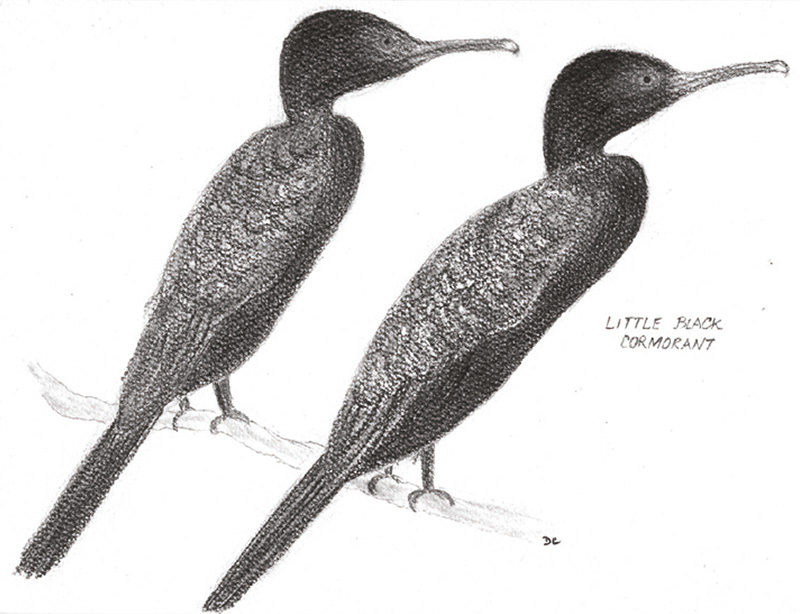
Little Black Cormorants. Drawing by Desraé Clarke.
The Toodyay Naturalists’ Club welcomes sightings and observations of flora, fauna and all areas of natural history. To add your sightings, email secretary@toodyaynats.org.au or submit a sighting via our online form.